boards /rodeo-motherboard
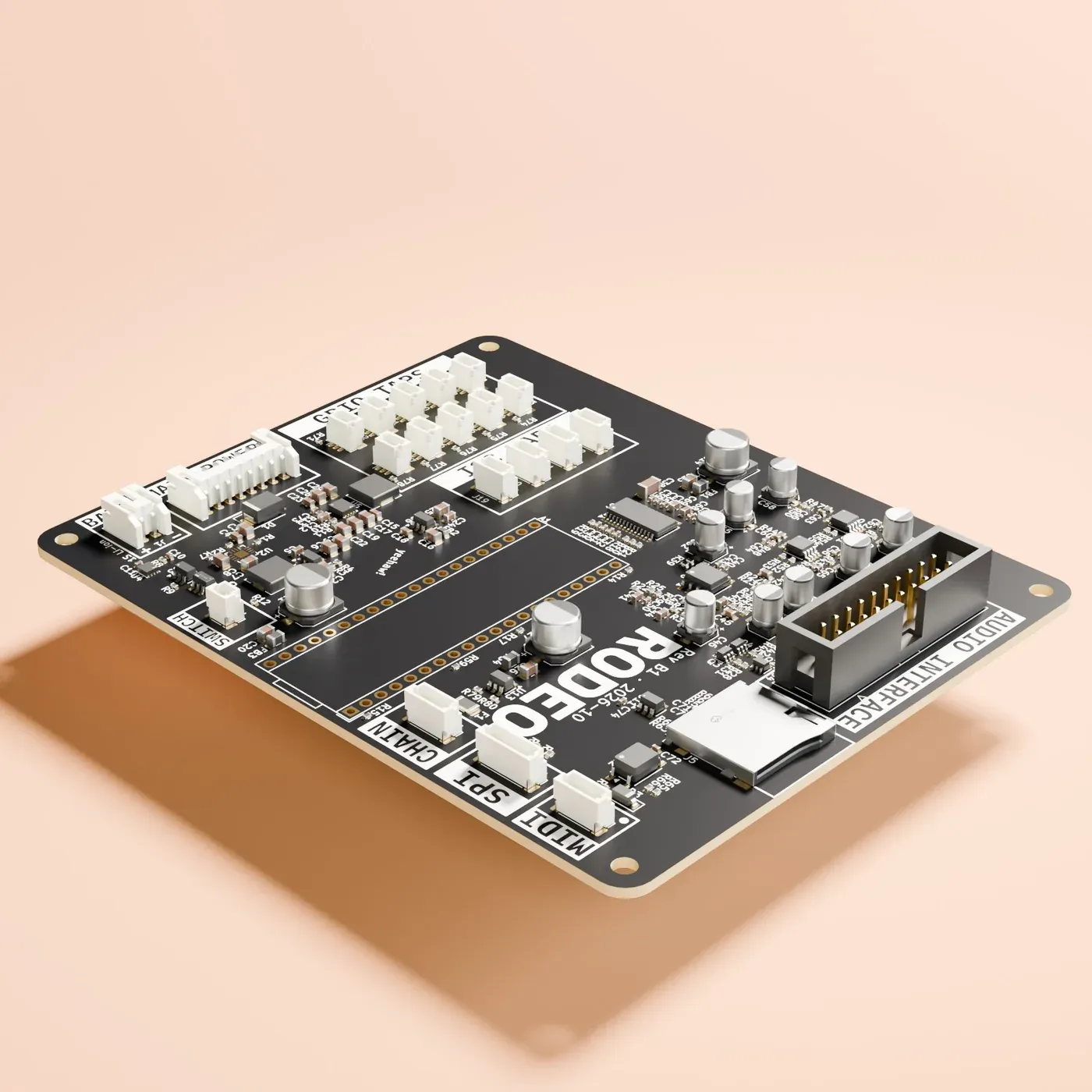
Host board
rodeo-motherboard
VerifiedThe motherboard has one job: carry the Daisy, the audio, and the connectors everything else plugs into. There are no converters on it: those pins drive a second codec instead, and high-resolution analog moved to an optional expander board. Controls no longer compete for motherboard channels, because the satellite chain grows by adding satellites. It also carries the battery, its charger and a fuel gauge, so the instrument charges over USB-C and runs off the desk.
- audio
- 4 in / 4 out, both codecs in one callback
- general-purpose I/O
- 10 connectors, 8 analog-capable
- control growth
- satellite chain on USART3
- I²C
- 4 taps, pull-ups on board
- storage
- internal SD — 1.24 MB/s read, measured
- USB
- audio, MIDI, serial and disk mode, all on the USB-C
- MIDI
- on a daughterboard
- power
- 1S Li-ion, charger and fuel gauge
- expansion
- SPI header, looped byte-exact to 6.2 Mbit/s
It boots. The Seed came up on this board on 2026-10-28, and nine of the eleven bring-up tests have passed on it since: both codecs, MIDI, the I/O connectors, the satellite chain, the SD card, USB-MIDI, disk mode, USB audio and the SPI header. Only the OLED test has not been run.
The battery gauge on the board we have is dead, and that is our fault: J1’s pin order is the reverse of every cell in the building, the first one went in backwards and the board got very hot. The MAX17048 has answered on I²C with 0 V ever since. The next revision swaps J1 and adds the reverse protection B1 went without.
The second codec’s ADC takes corrupted samples whenever its own DAC is playing — a layout fault, SDOUT running 0.15 mm alongside SDIN and SCLK for about 50 mm. Sending the DAC 16-bit words cuts it roughly a hundredfold, which is why USB audio defaults to 16-bit. The next revision moves the trace and adds series resistors.
No on-board ADCs. The two ADS114S08s, their 24 pot connectors and the pull-downs are removed; that bank becomes an optional expander on the SPI header.
More views
Top and bottom, from the KiCad files
-
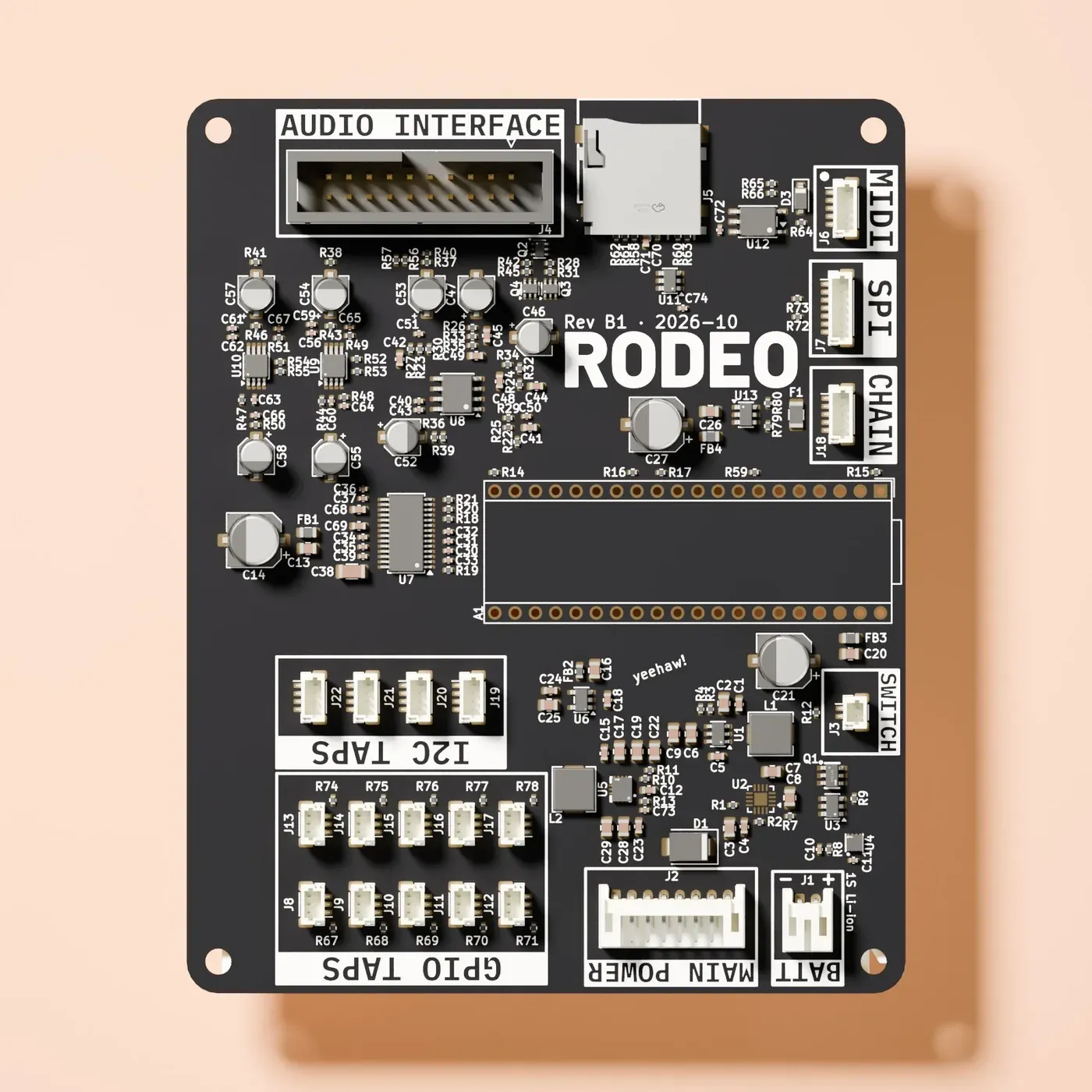
Rev-B— top · CAD render -
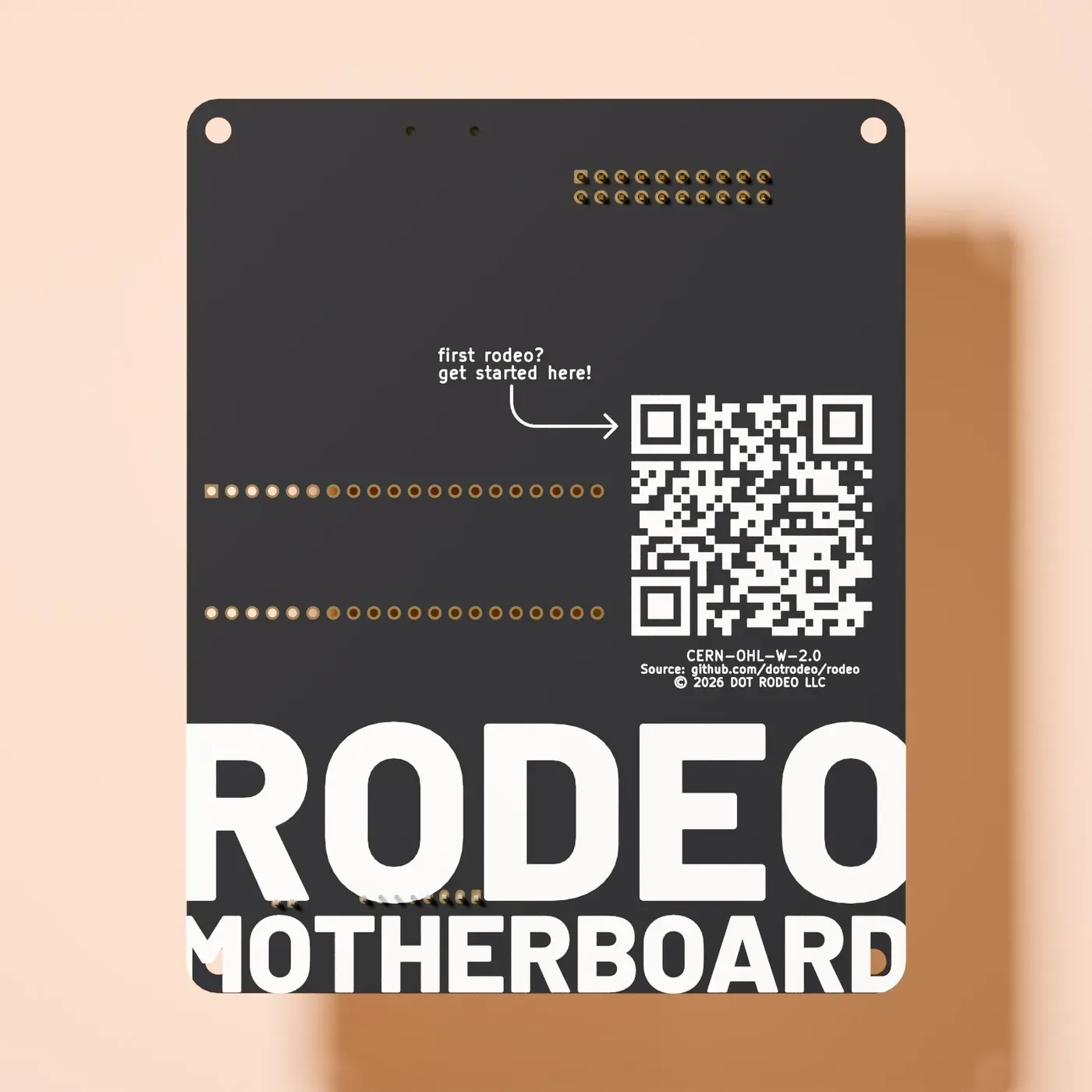
Rev-B— bottom · CAD render
Files
Published with the board
Nothing here sits behind a sign-up. Fork a satellite, respin it, and the host still reads it.
- .kicad_pro KiCad project Schematic, layout, footprints. link pending the public repo
- .zip Gerbers Fab-ready, plus drill maps. link pending the public repo
- .csv BOM + CPL Parts and placements. link pending the public repo
- src Firmware Where the board has its own. link pending the public repo
The rest of the family
Want in?
Rodeo goes to Kickstarter in January 2027. The waitlist hears first, and day-one backers are planned to get an early-bird price. One email to confirm, then nothing until there is news.